• Skip to primary navigation
  • Skip to main content
  • Skip to primary sidebar
KI4CFS

KI4CFS

Amateur Operator - Martin Brossman - Extra License - KI4CFS

  • KI4CFS
  • Articles
  • Ham Radio Groups & Forums
  • Ham Radio Gallery
  • Amateur Radio Resources
  • Location
  • Contact Us
  • About Me
You are here: Home / Archives for 2020

Archives for 2020

Greenland Movie Ending, CQ CQ & Ham Radio (SPOILER ALERT)

December 25, 2020 by Martin Brossman Leave a Comment

The movie Greenland depicts cell phone communication working very poorly or not at all, as the world is facing extinction. Then at the end of the movie we hear from the survivors in the bunkers calling  “CQ CQ CQ This is Greenland Station is anyone receiving” several times,  then a response “Greenland Station this is Helsinki .. the signal is weak but we reach you.. We copy…” then “This is Sidney station..” Five over nine, this is Moscow station….”  

This is clearly represented as some type of radio communication. I believe it is most likely analog HF communication. This is very familiar to most Ham Radio (Amateur Radio) operators as a way to call out to see if anyone is there, then Identify ourselves by giving our registered call sign like “CQ, CQ, CQ, this is KI4CFS: Kilo, India, Four, Charlie, Foxtrot, Sierra. CQ, CQ, CQ” Then wait to see if someone responds. 

You can here it here in this Youtube clip: Greenland End of the World Scene II Ending Scene II 4K & 1080p II Greenland 2020 II

https://youtu.be/Yvxer9EdQr8

CQ – Calling Any Station (Morse Code abbreviation) is generally used in Amateur Radio (Ham Radio) “HF” bands using many modes. From Wikipedia: “CQ is a code used by wireless operators, particularly those communicating in Morse code, (— · — ·  — — · —), but also by voice operators, to make a general call (called a CQ call). Transmitting the letters CQ on a particular radio frequency is an invitation for any operator listening on that frequency to respond. It is still widely used in amateur radio. More on the history of CQ can be found here: https://en.wikipedia.org/wiki/CQ_(call) . “ 

5 over 9 (59) means that the signal was clearly heard and was strong. 5 means “Perfectly readable” and 9 means “Extremely strong signal”.  http://www.acsu.buffalo.edu/~maxwell/RSTInfo.html#:~:text=For%20example%2C%20a%20signal%20of,readable%20and%20extremely%20strong%20signal.   Five over nine is a “Signal strength and readability report” on how a message was received  

https:/s/en.wikipedia.org/wiki/Signal_strength_and_readability_report 

Ham Radio and Morse Code offer a simple but highly robust method of communication that can work with a backup battery or solar panel and rechargeable battery and does not need the internet or real fancy cell phone towers for basic analog communication. You never know when you need it! If you are not part of the Ham Radio community, maybe it is time you look into getting your basic Ham Radio License and radio, just in case or just for fun. 
Learn more about Ham Radio here https://ki4cfs.com/what-does-it-take-to-become-a-ham-radio-or-amateur-radio-operator/  or follow my Ham Radio Youtube channel. https://www.youtube.com/c/KI4CFSHamRadioMartinBrossman

– Martin Brossman – KI4CFS

Filed Under: Ham Radio in Movies & Life Tagged With: Amateur Radio, CQ CQ, Greenland Movie, Greenland Movie Ending, Ham Radio, KI4CFS

Online Ham Radio Remote Testing with Anchorage VEC

April 22, 2020 by Martin Brossman Leave a Comment

Martin Brossman, KI4CFS, interviews, Kent Petty, KL5T, and Brandin Hess, AL6I with the Anchorage Amateur Radio Club, which was the 1st to offer remote testing. They are big supporters of other groups working on the same project.

There websites and links mentioned in this video Anchorage Amateur Radio Club main page: https://kl7aa.org/ Anchorage ARC VEC page: https://kl7aa.org/vec/ Anchorage ARC VEC Remote Testing page: https://kl7aa.org/vec/remote-testing/ Anchorage ARC Membership page: https://kl7aa.org/aarc-membership/ Anchorage ARC Donations page: https://kl7aa.org/donations/cash/ They are also exploring ways to a way to allow active-duty service members and veterans to test for free thought funding. If you are willing to help contact them. Martin Brossman – KI4CFS – HTTP://KI4CFS.com & my Ham Radio Facebook page: https://www.facebook.com/KI4CFS/ Also, join our “Learning and Passing the Amature Radio Exams” Facebook group: https://www.facebook.com/groups/LearningHamRadio/ If you are in the NC area join our group “NC Ham Operators” https://www.facebook.com/groups/NCHamRadioOperators/ For updates on remote testing, in general, see https://wiki.wx0mik.net/doku.php/licensing/us/onlinetesting #HamRadioTesting #AmateurRadioTesting #HamTesting #HamRadio #AmateurRadio #Anchorage #KI4CFS

Filed Under: Uncategorized

FCC Ham Radio License Test Online – Highened interest during the Coronavirus (COVID-19) crisis

April 5, 2020 by Martin Brossman Leave a Comment

Ham Radio Testing Online will be very different than in person.
Where I and a friend took our last exams in-person. Him the Tech and me Extra

What we know about Amateur Radio Exam Testing On-line so far.
Contributors Martin Brossman, KI4CFS –  Mike Wills, WX0MIK – Paul Gerads, KE0VWZ – Randy Hill, KO4CWC 

The primary interest offering ham radio testing available to people at home and online is for those that are isolated, disabled veterans that may not have mobility or people with other challenges and disabilities where someone could not help take them to a testing location.  We’re still a big advocate that the in-person way to take your exam is at a physical testing location with VC’s overseeing the testing because it’s a great experience and a way to meet some of your local ham radio community. With the coronavirus crisis and the requirement for people to isolate at home this is brought more attention to the idea of online testing.

If online testing is made available the first priority is going to be to guarantee the same Integrity that exists with an in-person testing location. Where are you need to have no open books, the right type of calculator that can be cleared, and there is not a way to be able to cheat. There are a lot of variables to consider and not to just implement the easiest possible way which is clearly what ARRL and other VEC having to take into account.  

Our goal here is to provide you with links to learn about the latest facts related to online testing. If you are interested I invite you to make sure you’re an ARRL member and then communicate in a constructive way that this is something you’d like to see happen and offer to volunteer if any help is needed.  

A number of things that need to be considered

  • The examiners are all volunteers – VE (which limits some of the resources you may have in a profit-driven business0 
  • We need to make sure they are not cheating which is much easier to do if they are sitting in front of us.
  • How to get the 3  volunteer examiners – VE to be able to verify the test results 
  • That the FCC see that we had dotted all our “I”. 

Martin’s KI4CFS views on this topic  Offering Ham Radio testing remotely during the Coronavirus crisis

My interest in Remote Ham Radio Testing and why I think it is important.

Resources we have so far:

For updates on remote testing, in general, see https://wiki.wx0mik.net/doku.php/licensing/us/onlinetesting

The link we were pointed to when we contacted the ARRL “To All ARRL Members and ARRL VEC Accredited Volunteer Examiners”

http://www.arrl.org/read-a-message-for-members-and-volunteer-examiners

The 1st place that did the testing is Alaska because of the remoteness of people in their state.  ANCHORAGE AMATEUR RADIO CLUB – https://kl7aa.org/remote-testing-expanded/

“USA conducts first all-online ham radio exam”
https://qrznow.com/usa-conducts-first-all-online-ham-radio-exam/

Youtube videos

My interviewee with the Anchorage Amateur Radio Club team talking about being the 1st to offer remote Ham Radio Testing

ARRL On Ham Radio Testing, License renewals & Field Day and COVID-19

Part-2 Ham Radio Test Online! – First Recorded Technician License Completion
https://youtu.be/bF_KSe-Hyl8 

Part-2 Ham Radio Test Online! Follow-Ups and Progress Reports – HamStudy.org

Join our Facebook group, “Learning and passing the ham radio exam”  https://www.facebook.com/groups/LearningHamRadio/ 

Contributors to this article online resources:

  • Support Ham Radio Facebook Page: https://www.facebook.com/ki4cfs
  • Learning and Passing the Ham Radio Exams Facebook group: https://www.facebook.com/groups/LearningHamRadio/
  • If you are into Ham Radio in North Carolina then join us in the Facebook group: https://www.facebook.com/groups/NCHamRadioOperators/
  • Youtube – KI4CFS – Ham Radio – Martin Brossman https://www.youtube.com/c/KI4CFSHamRadioMartinBrossman

If you know of any resources that we need to include please post them in the comments. 

Filed Under: Uncategorized Tagged With: Amateur Radio Testing Online, FCC, Ham Radio Testing Online

What does it take to become a Ham Radio or Amateur Radio operator?

March 18, 2020 by Martin Brossman 2 Comments

What does it take to get into Ham Radio?
How can I learn more about Ham Radio?
How do I get started in Amateur Radio?
Is it really expensive to get into Ham Radio?
(Contributors Martin Brossman KI4CFS, Charles Murry KI4DCR, Chris Cancilla, Randy Hill)  

The goal of this document is to answer the basic questions about what is required to get involved with the Hobby of Ham Radio which is also called Amateur Radio.

Amateur Radio or” Ham Radio” is a wonderful hobby about radio communication that requires at least a “Technician” license to communicate on the radio. This is a great thing because we all have earned our way onto the airwaves and all know the basic rules. When people can be anonymous, or there is no barrier to entry, they tend to not be as nice and due to the fact you need to both have a license and self-identify yourself, by giving your call sign (eg. “KI4CFS for ID”), it attracts a more responsible person. The organization for Ham Radio in the US is American Radio Relay League (ARRL). A quote from the ARRL.org website: “Amateur Radio (ham radio) is a popular hobby and service that brings people, electronics, and communication together. People use ham radio to talk across town, around the world, or even into space, all without the Internet or cell phones. … You can set up a ham radio station anywhere!” learn more from this article on ARRL – What is Ham Radio?” http://www.arrl.org/what-is-ham-radio

The basic steps to be able to talk on an Amateur Radio, transmitting over the airways include:

  1. Study the Ham Radio Technician License content and test exams. (http://www.arrl.org/getting-licensed and http://www.arrl.org/ham-radio-license-manual ).  
  2. Get an FCC FRU number (this protected your Social Security Number). https://apps.fcc.gov/coresWeb/publicHome.do
  3. Find a please to take the Amateur Radio testing location and pass the Amateur Radio Technician Exam. ( http://www.arrl.org/find-an-amateur-radio-license-exam-session )
  4. Get an Amateur Radio and I recommend starting with a handheld radio for under $100 (or start with http://www.echolink.org/).
  5. Make sure you get confirmation from the FCC (by email) that you’re in the system and have been granted a call sign. Or you can search here: https://wireless2.fcc.gov/UlsApp/UlsSearch/searchAmateur.jsp – Entering your FRU # is the best way to check, leaving all other sections blank).
  6. Find a local “Ham Radio Repeater” or several near you and program them into your radio. We recommend finding a Ham Radio Club in your area and see if someone can help you (http://www.arrl.org/find-a-club).
  7. Talk on the radio! 

A little more details: 

You need to pass the basic amateur radio technician level test before you can transmit on the ham radio frequencies.

The Amateur radio basic technician license testing is offered at specific locations all over the United States, on specific dates and involves special volunteers VE.  To administer and grade your test. The cost is generally about $15 to take the test, and in some areas, it can even be free.

Get The Book
All of the questions and answers are available and you need to get a 74 or above on the technician license test to pass. To prepare for this test most people will buy the ARRL amateur radio handbook or a study guide designed to prepare you for the latest level of technician license testing. Make sure if you get a book it is preparing you for the current series of test questions and it should say on the cover that it prepares you for test questions going through a date range. If that date range is passed then that book is of no value for preparing for the current test.

Books you could use to prepare for the Tech exam
(Always make sure that the book is still current by checking the date range)

The main book from ARRL – The ARRL Ham Radio License Manual Spiral Spiral-bound – June 4, 2018 by ARRL Inc

Another book – Technician Class 2018-2022: Pass Your Amateur Radio Technician Class Test – The Easy Way https://www.amazon.com/Technician-Class-2018-2022-EasyWayHamBooks-Book-ebook-dp-B079S3LJ8B/dp/B079S3LJ8B/ 
2018-2022 Technician Class Perfect Paperback – May 1, 2018 by Gordon West  https://www.amazon.com/2018-2022-Technician-Class-Gordon-West/dp/0945053908/

Here is free PDF but I have not tested it https://www.kb6nu.com/study-guides/

If you know of online training that you recommend please post in the comments.

Find a Ham Radio Club
I highly recommend looking up to see if you can find a ham radio or amateur radio club in your area and show up at one of the meetings to find out what local resources are available to help you because it will be very useful to be able to sit down with someone local and get help. Also, it will connect you to the local area of amateur radio groups. They are generally very helpful for new people.

Take the Test and Pass it
Find a place to take the test and follow the instructions to sign up to take the test on the date and time available. Once you pass the test you will be notified by email that you have received a call sign allowing you to speak on the radio and it’s important to use this callsign whenever you transmit. If you fail the test just take it again until you pass. 

A place to take a practice exam:
https://www.qrz.com/hamtest/

A place to find where you can take your Ham Radio Exam. If you do not find one in your city then try the next larger city near you. 
http://www.arrl.org/find-an-amateur-radio-license-exam-session

Get a Radio
Then you either need a radio designed to transmit on the legal bands of the amateur radio

Actually you don’t even have to have an Amateur Radio. You can download a program called Echo link if you have a PC or download the EchoLink app and register with your new call sign and be able to start speaking throughout the world over amateur radio with your phone or a microphone connected to your PC. At this time I don’t know of echolink working on a Macbook but it does work on an iPhone.

As far as buying a radio you can spend as little as under $30 for Chinese radio that will transmit on the 2 m and the 400 bands of amateur radio. I’d recommend it if you can afford to buy a lower end brand-name handheld radio like Yasu or ICOM for around $100 dollars. They are better made and easier to set up.

Echolink (best to get a ham club to help you)  http://www.echolink.org/

BaoFeng UV-5R Dual Band Two Way Radio (Black) by BAOFENG
https://www.amazon.com/BaoFeng-UV-5R-Dual-Radio-Black/dp/B007H4VT7A/

Yaesu FT-4XR 5W VHF/UHF HT
SKU: ZYS-FT-4XR
https://www.gigaparts.com/yaesu-ft-4xr-dual-band-transceiver.html

Here is a table on the cost of getting into Ham Radio 
https://docs.google.com/spreadsheets/d/1OzqQsa1vDcTZx6aIxprXBzcshTi0A2kot-vvZhunxU0/edit?usp=sharing

Talk on the Radio
Once you have a radio we need to find what are called repeaters in your transmission and reception over up to several hundred miles.

Remember this is a hobby so you’re going to have to fuss with things; you’re gonna have to ask people for help; you might have to watch some YouTube videos, learn the new aspects of the hobby and it has many different avenues and dips to it so don’t let yourself become overwhelmed just take it one step at a time.

Your next challenge is to figure out how to get your radio to transmit and get the courage up to put your call sign out like this, “this is KI4CFS monitoring and want to see if anyone hears me I am a new amateur radio operator”. Then the next step is to see if you can find what is called ham radio nets which are organized discussions at a set time on a certain frequency and they will give you instructions on how to “check-in and talk on the net. Your next goal is to successfully check-in and talk on the net. 

Don’t get discouraged if someone corrects you but appreciate it because they’re there to help you. Also, this is why it’s useful to try to find either a local Group to get involved in and meet so they can personally help you get on the airways.


I recommend joining the local club which is only for a few dollars a year and after that. If you can, I recommend joining ARRL with the annual subscription. And you’ll learn a lot from both. There’s a lot of people out there willing to help you if you’re coachable and can handle someone giving you corrections and advice along the way. Online Forums and Group you may find more information 

https://docs.google.com/document/d/1dai2BBJd3rpGbbTpDfi3DOYnnHpm6UAU3SL9TloNdmk/edit?usp=sharing

Martin Brossman KI4CFS on the web:

Ham Radio Facebook https://www.facebook.com/KI4CFS/
Youtube: http://www.youtube.com/c/KI4CFSHamRadioMartinBrossman

Facebook groups: 

  • Supporting people learning and passing the Ham Radio Exams – https://www.facebook.com/groups/LearningHamRadio/ 
  • To help connect all Ham Radio Operators across NC – https://www.facebook.com/groups/NCHamRadioOperators/

Share resources you recommend in the comments below.

Filed Under: Uncategorized

What Can I Do to Grow the Ham Radio Hobby?

February 6, 2020 by Martin Brossman Leave a Comment

Reprinted from the February 2020
Raleigh Amateur Radio Society’s EXCITER

RARS Exciter 2-2020

I’m back into Ham Radio after many years of being out and I love it even more now!

I live in Raleigh, NC where I’m self-employed with wife Barbara KI4GUM. As an only child, it fell to me to care for my parents, who lived in DC. A few years ago they peacefully passed in their home, and about that time I remembered how much I enjoyed Ham Radio. As I was driving to a family reunion near Allentown, PA with my friend who helps me drive each year, Paul Apollonia, N3GCA, who is a Ham from Philadelphia, the subject naturally came up.

We stopped in HRO to buy an ICOM ID-51A because I wanted a radio that could do digital and they said that D-Star was more active on the east coast. Then I found out that we don’t have a D-Star repeater working in this area yet (fingers crossed). Check out my video “Getting Back Into Ham Radio” http://bit.ly/backintohamradio.

When I returned to the hobby I realized I wanted to do my part to help grow Ham Radio participation in productive ways. My business keeps me extremely busy so whenever I leave the house I need to make money. I decided the best way for me to fulfill this commitment is by applying my Success Coaching and marketing skills.

I am enjoying myself immensely helping people pass their various Ham exams, expanding awareness of the hobby and encouraging constructive use of Ham Radio. Yes, in our current world, people are on their cell phones a lot and yes, there are probably a thousand ways Ham Radio is not what it “used to be,” but continuing to lament these facts won’t make any difference.

For myself, a more effective approach is to ask: “what can we each do today to promote this hobby that we love so much?” In order for Ham Radio to continue flourishing, we must make peace with the existence of social media and smartphones. Almost 3 and a half billion people now use social media, the majority of them on their smartphones, which is about 3/7th of the entire planet. Instead of complaining, I say let’s put social media to work for us by using it to collect new members and to share the value of Ham Radio.

Here are the actions I’ve taken thus far:
– My Ham Radio Youtube channel, with 200 subscribers: http://bit.ly/backintohamradio
– My Facebook page, started on Dec 8, 2019, with over 1800 likes: https://www.facebook.com/ki4cfs
– My Learning Ham Radio FB group with over 160 members (started in December) https://www.facebook.com/groups/LearningHamRadio/ and
– My website for relevant resources and content http://KI4CFS.com

You may wonder if I’m getting paid somehow for these actions, or what’s in it for me. I have multiple answers: for one, I get a personal high from the idea that I might be able to make a difference in Ham Radio on a global level. I have invested about $300 of my own money to get started, now I need to invest only my time and attention.

If I’m ever selling a product, it would be just for personal fun–I will only put it on my website – KI4CFS.com (I would never mention it on the air or put it on my other Ham Radio sites). If I am given any products to review, I will fully disclose the relationship I have with that product’s seller. I aim to keep my participation with Ham Radio pure.

My mission is the constructive global growth of Ham Radio today! If you have a similar mission I’d like you to join me.

If we don’t use it we will lose it! I know that there are a lot of great aspects to Ham Radio today that could enhance the lives of people of all ages no matter where they live. I believe that if something good happens in Ham Radio and you don’t share it online then you are acting as if nothing good happened. I also believe that if you listen without at least sharing your call sign then you are robbing us all of your company and if you don’t talk, your wisdom, plus you are robbing yourself of the benefits of connecting with others.

It is our responsibility to let the world know what is fun, useful and beneficial about Ham Radio; it is not the world’s responsibility to discover it on its own. If you don’t hear anyone on the airways that is because YOU are not speaking. Please at least try to put out a long and clear call mentioning the frequency.

Want to help me directly? Offer to let me interview you on some educational topics for the Youtube channel. Visit my web pages and like, share or comment there. Share any relevant content you think has value.

For those of you who find yourselves talking about how it used to be, cut it out! Instead, ask yourself what you can do today to support this great hobby. Keep taking action in a positive direction. One more update, I just passed my Extra exam. That was hard.

You may enjoy my article, “What Can I Do to Grow the Ham Radio Hobby?” http://bit.ly/growhamradio
Thanks to Raleigh Amateur Radio Society’s EXCITER for publishing my article and learn more about RARS at https://www.rars.org/ and if you are in the area make sure to come to their Ham Fest (RARAfest) in April
https://www.rarsfest.org/
Martin Brossman
KI4CFS, 73

Me with a few of my Ham Radios

Filed Under: Uncategorized

How do you add a repeater to memory on the BTECH UV-5X3?

February 3, 2020 by Martin Brossman 2 Comments

Steps for programing in a Repeater on the Baofengtech BTECH UV-5X3 Ham Radio Tri-band Transceiver

Contributors: Martin Brossman, KI4CFS (http://KI4CFS.com/ ) and Jim Unroe KC9HI (http://www.miklor.com/) . 

Note: This radio will let you set an “offset” in “Frequency Mode” or VFO mode but it does not let you save in memory. To save a repeater in the memory you need to first save the receive frequency, the frequency that the repeater transmits on. Then we save the frequency that the repeater receives on (including a Tone if required). For example, if your local repeater is 146.640 with no tone. The offset for that repeater is -600 (600KHz or .6MHz). Then the second number you will save in memory is 146.040 (146.640 – .600). 

BTECH UV-5X3

If you want to put in a simplex frequency, like 146.520 then you would save it once for “Receiving” Memory. 

Steps for saving a repeater in the BTECH UV-5VX3

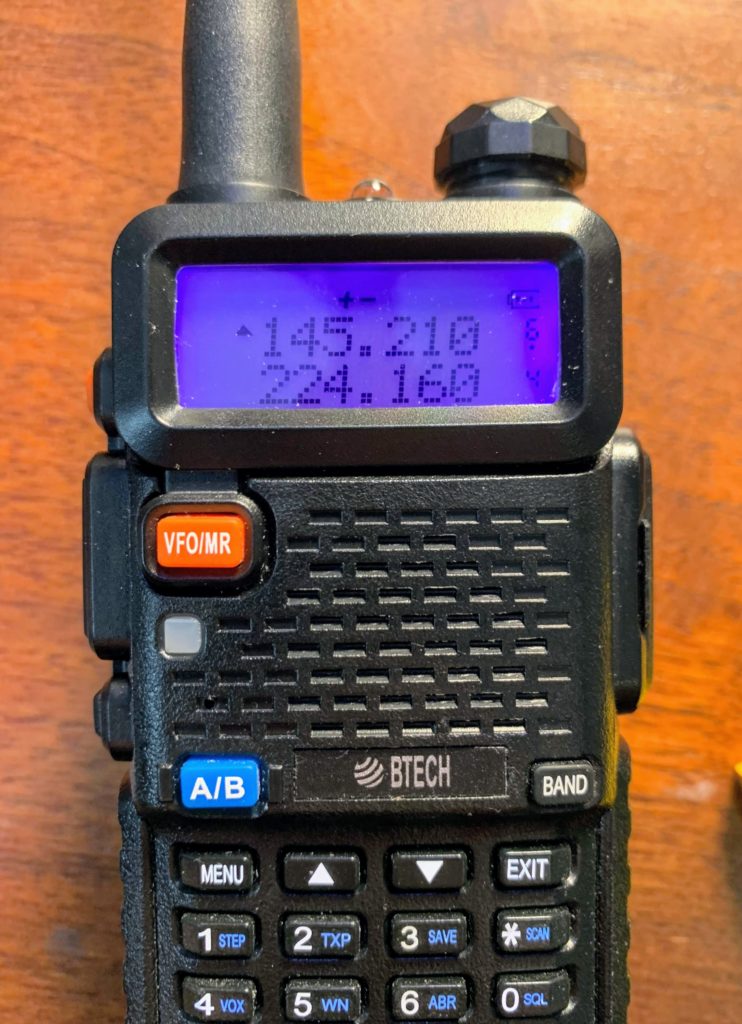
Let’s say you want to access a 220 repeater. One in my area is 224.160 with an offset of -1.6 Mhz and a tone of 91.5 Hz. 

1st you need to calculate the Transmit frequency and that would be 224.160 – 1.6 = 222.560. This means I want my BTECH UV-5X3 to transmit on 222.560 (sending out a “sub-audible” tone of 91.5) and receive on 224.160. 

You can only add a channel to a memory location that is empty. 

We need to be in “Frequency Mode” or VFO by pressing the orange button (it toggles between “Frequency Mode” and “Channel Mode” or MR) 

You need to have the little up triangle on the top line.  Press the blue button “A/B” and notice how the little upward-pointing triangle to the left of the number point. It needs to be on the top line before you put in the frequency. 

Next use the keypad to enter the frequency of the “Repeater”, the receiving frequency or the transmitting frequency of the Repeater (all the same thing, just different views and ways to say it). 

Note: When you press “MENU” if you wait too long before you do something it will pop back to whatever was on the screen before you press “MENU” (timing out). Just press “MENU” and continue. 

Press “MENU” and type in 27 or use the up and down arrow till you see “MEN-CH”. Then press again “MENU” to jump to the lower line with the memory channel (the menu’s edit mode). If you see CH and a number something is saved in that memory channel. You can use the up and down arrows on the keypad to find an empty memory channel.  

Once you see the memory channel you want to save the repeater in then press “MENU” again and you should hear “Receiving” Memory. Now the frequency to “listen” is saved. 

Next press “EXIT” for exit and in the “Frequency Mode” or VFO mode enter the transmit frequency (In our example that would be 222.560). Note: If you are math-challenged you can set MENU 25 (SFT-D) to “-” and MENU 26 (OFFSET) to 001.600 and tap the [*] key to put the radio into “reverse” mode to display the TX frequency (an “R” will appear in the upper-status display area).

If the Repeater requires a tone follow the next step and if not skip it.

Next, you will enter the “tone” to transmit along with the transmit frequency by selecting “MENU” and go to “MENU” 13 (T-CTCS) by entering 13 on the keypad or using the up and down arrows to get to 13. Click “MENU” a second time and it will jump down to the line to select the transmit sub-audible tone. If you have not added this before you will see the word “OFF”. Press the up or down arrows on the keypad till you see the tone required by the repeater or jump directly to it by keying it in. In our example that would be 91.5. Then click “MENU” again to set the tone and “EXIT”.

You will be saving the transmit frequency in the same memory location next. Press “MENU” enter the number 27 and press “MENU” again. Make sure it is still on the same memory location and press “MENU” again. You should hear “Transmitting  Memory” and it is set. Press “EXIT” to exit. If you used “reverse” mode to set the TX frequency, don’t forget to tap the [*] key to exit “reverse” mode (the “R” will go away).

Toggle the orange “VFO/MR” button to “Channel Mode” or MR. Use the up and down arrows or key in the 3-digit channel number to get to the memory location you just saved the repeater on and click to talk. Of course call out your call sign when you test it. If you are in range the repeater should open and you will hear a response.  See this video of a similar radeo https://youtu.be/CrG0El1KkIM 

A video walking through the basic steps above?

Q&A

How do I save a frequency that I just want to monitor and not transmit to?

If you want to just listen to a frequency and not broadcast on it, here is a trick that will minimize the risk of broadcasting on a channel by mistake that would cause a big program. 

you wanted to manually program a channel to monitor a frequency and make sure you were not able to transmit on that frequency, this would be your only option.

For this exercise, we are wanting to monitor 162.450 MHz (one of the NOAA weather radio frequencies in the USA). We have already switched the radio to VFO mode, selected the top display line, erased memory 004, set STEP to 2.5 K and set TXP to LOW.

key in 162450 [NOAA WX Radio frequency] store to memory 004 using menu 27 key in 462713 (will automatically round down to 462.7125) [GMRS ch 7] store to memory 004 using menu 27

Now you can monitor the NOAA WX Radio on channel 4 and if you accidentally press the PTT button, the transmission would be on GMRS channel 7. Not strictly legal, but a much better option than transmitting on 162.450 MHz. If you are a ham, you can set TX to any frequency in the 2 meters, 70 centimeters or 1.25 meter (if available) bands where FM transmissions are permitted and won’t cause interference.

How do I save in memory a simple simplex frequency like 146.540?

There is no need to save twice. Please try this to see for yourself. Program a memory. As soon as you complete the step where the radio says “receiving memory”, stop. Switch to MR (channel) mode, select the channel that was programmed and press the PTT button. It will transmit because it is already a simplex channel. The second write for a repeater (or odd-split or cross-band) channel is just converting a simplex channel to a duplex channel. 

How do I delete something from memory? 

Press “MENU” once, then enter the number 28 on the keypad or use the up and down arrows till you get to 28 and see “DEL-CH”. Next press “MENU” a second time and notice the little up arrow (or triangle) on the goes down a line and become a down-facing arrow (or triangle). You will hear “Delete Channel”.  Use the up or down arrows to select the memory location you want to delete. Memory locations that have something stored in them look like this: “CH-127” and memory channels that don’t have anything stored in them look like this: ” 127”. When you find the memory channel you want to delete press “MENU” again and you will hear the word “Confirmed”. You can then exit “MENU” by pressing EXIT”. If you do not move fast enough it will leave the “MENU” mode and you will have to press “MENU” again. If you want to leave without deleting press “EXIT”

How do I adjust the squelch?

Select “MENU”, then press 0 and you will see “SQL” with a number under it. Press “MENU” a second time and the little triangle or up-arrow on the top line will jump to the bottom line and you can use the up and down arrows on the keypad to change the number or just enter the number. In most cases, a level of 1 or 2 will work. Last press “MENU” again and you will hear it say “Confirm” . You can then click “EXIT” to leave the menu.

Also, check out these resources:

Programming Your Baofeng UV-5R Radio
http://www.iwillprepare.com/files/pdf/baofeng_%20uv5r_manual_programming_guide.pdf

UV-5X3 Tri-Band Handheld VHF / UHF / 222-225 MHz http://www.miklor.com/BT5X3/

Facebook BTECH UV-5X3 and UV-25X4 (Baofeng Tech)
https://www.facebook.com/groups/uv5x3/

My Facebook page:
https://www.facebook.com/KI4CFS/

Filed Under: Handheld Ham Radio Tagged With: BTECH UV-5X3, Handheld Ham Radio

A story of an Amateur Radio Emergency Communication Van

February 1, 2020 by Martin Brossman 1 Comment

Ham Radio History – A story of an Amateur Radio Emergency Communication Van that Ernie Martin – WØAUU, was involved, in his own words. Posted by Martin Brossman KI4CFS

The Amateur Radio Emergency Communication Van

That old 1970 Chevy step van was a pile of junk and needed everything.  We rebuilt the engine and had the transmission rebuilt. The steel studs on the inside most had rusted off at the bottom we had news ones made at a local trailer factory.  Then added wood 2X2 studs so insulation could be added. We had new lower side panels made and put on and added a window and had it painted. We insulated the floor and put in electric heat.  Then added a light bar to the top that had red, green and yellow lights. We did have a state red light permit but never used them. That old van was too big to run with red lights so I removed that fuse just to be sure.  We did use the combination of yellow and green lights a few times. There were two banks of 12-volt batteries, each bank would run all the radio gear for two hours. They could be charged from the engine or from a gas generator and we also had 13 volts of solar power that would charge the batteries.

The lights
The Van!

There were four operating stations, one for 80 meters, one for 20 meters, one for 2 meters and the mobile repeater and one for FRS and ATV.  We had a radio for aircraft communications, one for tugs on the Mississippi it even had a satellite phone that the Red Cross used several times. Yes, it even had a CB radio. It had a flip-up 2-meter beam on the top.  When we pulled in and parked we were on 2 meters in two minutes. Getting the dipoles up for 80 and 20 took some time, most of the time all the trees were gone after a tornado. We were on the air the night of Y2K, we were in a small town in southern Minnesota.  On 80 meters we were able to talk directly to the Governor’s office in St. Paul. and you know how bad the bands were that night, everybody was on.

Some of the radios

WE worked with several search and rescue dog teams looking for missing persons that is where the FRS radios came in handy because none of them were licensed hams they could not use 2-meter handheld.  We did get our county sheriff to give us a county radio number and we had a police radio in the van that was used several times. We responded several times after a tornado had gone through and there was nothing left.  The Red Cross was all ways glad to see our van because they knew we could send free radiograms for people and we sent thousands of them. IF you are going to do that, you NEED to have your forms printed and they have to check what message they want to send. they were printed what they had a choice of, we had things like……We are all fine the house did have some damage or  We are all fine house is ok the message needs to be pre-printed because if not people tend to get way too long.

More of the radios

We could run all the gear from batteries or some from solar and all from a gas generator.  We had two 45 amp inverters and one 75 amp inverter if the sun was down and the battery banks dead we ran from the generator.  IF we needed to use the electric heat then we needed to run the generator so we had 220 volts. We also put an AC unit on the top, that needs 120 volts AC so the generator was needed for that.  When we responded to an emergency we had everything with us we needed to run for four days right down to the toilet paper. Gear, tools, spare parts coax, connectors, all kids of wire and rope. Two pop up ten by tens with sides, tables even a ground rod and food and water and soda.  The rig did have a microwave oven for hot dogs and burgers and soup. The only problem we had was there was no place to sleep! So the ten by tens were used for that. It worked but could have been better. Most of the time when the van was out it was the same three guys who went they were all retired and had the time to go.

In the unit

The states of Iowa, Minnesota, and Wisconsin decided to have an emergency drill on the Mississippi River.  The plan was with all the diesel fuel and fertilizer that was being shipped up the river, Teresa’s got their hands on it and set it off and that took out a lock and dam on the river.  We had meetings for six months about how they were going to do the drill. Their plan was to use the VHF radio at the lock and dams to communicate with the mobile units. We tried and tried to tell them that that was not going to work.  We tried to tell them that their VHF signal would not be able to reach the mobile units behind the bluff. What do we know? At the last meeting, we did convince them to give us one of their radios to have in the com van. On the day of the drill we parked in a park overlooking the river, not only could we see for many miles we had radio communications for man miles in all directions.  IT was a good thing we had one of their radios because we ended up relaying all of the communications. The other problem they had, when the Teresa’s blew the first lock and dam when that wall of water hit the next dam downriver it took that dam out so they had no VHF communications. Or that is what would have happened in the real world. When the drill was over and the final report was written, ham radio got five words on the bottom of the last page.  If it wouldn’t have been for ham radio they would not have been able to have their drill.

Ernie Martin in the Navy (a few years ago 😉

The radio gear has been removed from the van but the inverters and all the wiring is still in both DC and AC.  All the fuses and circuit breakers are still in. The van is for sale if anyone is interested. Send me an email at    leewalt@powerbank.net 

We did all that with NO federal or state money! We raised all the money to do the work and buy all the gear by selling hot dogs, popcorn and burgers with NO help from the local chamber of commerce they just made it hard for us. In an emergency, we must all stand together no matter what our little differences maybe, in emergency hams will stand side by side to help. This gave us more autonomy to do what we felt was right. It is hard to describe how great it felt and how rewarding it was personally to be working together on a project like this to help our community.

In an emergency, hams are there to help. We will all stand side by side. There will be many jobs to do, not all of them connected to the radio. In some emergencies, I have been asked by the police to direct traffic. In other emergency’s I have been asked to help with the cleanup. Whatever we are asked to do we do it with a smile. We have worked with several dog search teams, whatever we do we are not there to be the news, most of the time we are behind the scene and out of sight. 73’s WØAUU

See more photos of the Ham Radio Emergency van at: https://photos.app.goo.gl/RXyf9LS6oVodp5Bm8

Some questions and answers with Ernie Martin:

Q. Why did you create the van?
A. Our ham radio club could see there was a need for emergency communications when we went to our first disaster and the Red Cross had no way to send messages to people in other places. The phones were out no cell phone when we started the van and we knew the ARRL had emergency message forms. WE could see that there was a lot of equipment needed. So one by one as the club had m money we added the gear that was needed. When we were done we had 80 and 20 and 2 and 440, FRS, ATV on 2 meters, aircraft and Mississippi river tug boat communications and radio for police communications and even satellite communications that the Red Cross used several times.

Q. How did you create it? and how did you fund it?
A. Well as you can see it took a ton of work just to get it ready to drive! The steel studs in the sides were all rusted off and it needed to be rebuilt from the ground up. No one in the club knew anything about bodywork so we just started working. As you can see it turned out great. Ask of the funding was done with popcorn, hot dogs and burgers! That took a tremendous amount of work! We went to every town event for miles around

Q. How was it to be of service to support traditional emergency services?
A. We had a county radio number from our county sheriff. With that radio, we were able to talk to the sheriff, police and fire and ambulance. We had a mobile 2-meter repeater in the van and that was used at all of the disasters we went to

Q. Can you share a few stories about how it was helpful?
A. The Red Cross liked to see us arrive so we could send emergency telegrams for the people that were effected by the disaster. When the Red Cross did their damage assessment they used the FRS radio in the van, we had a much better antenna than they did so we had better communications. When we were at St. peter, minnesota, the storm had taken down their AM radio station tower. They were crying OH IF we only had our radio station. We asked them what had happened to it and they told us the storm took down the tower. I said no problem we can build you an antenna and they all laughed at me. I got several guys out, some were to get me anything that could be used to make an insulator. other guys had the job to get me wire, any kind of wire. We had them get the station engineer there and from him I got the frequency. Now that I knew that I could figure the length of a dipole. On the AM radio band, I knew it was going tone very long. That antenna zigged and zagged up and down the street for several blocks. When we connected the coax to the center insulator we told the station engineer to fire it up. He didn’t think it was going to work so he gave it very little power till he could tune it, then little by little he turned the power-up. They found that it really did work and that they had a larger coverage area than their tower did. Now I know the FCC requires the AM radio stations to use a vertical but I thought this was an emergency. As soon as their tower was back up they used it

Q. How and/or why did you retire it?

A. It happens to all clubs the members get older. Some tased away, some moved away, it got down to where there were just not enough of us to do it any more. Our youngest member was 70. That was five years ago. The van has been kept inside all the time and still looks as good as it did on the outside. It would be a great emergency com van for three stations, we had to much gear in but everything was used. It would work really good for one rig on 80 meters and one on 2 meters. There is one thing we wish we would have had and we were working on it, that is we wish we would have had a good vertical antenna one for 80 and one for 20. When we got there there were no trees left so putting up a dipole was hard. We would go around and find broken 2 X 4’s, nail them together to get the dipole up and lucky if it was ten feet off the ground but it worked. WE built some very heavy duty dimples they were made out of lightning arrester cable. We had a spool of 500 feet of rope but used the rope that had already been cut but if we need more we had it. A coffee pot would have been great to have, we made coffee in the microwave oven.

73’s WØAUU

The story was shared on Martin Brossman Ham Radio page https://www.facebook.com/ki4cfs

Filed Under: Uncategorized Tagged With: Amateur Radio, Amateur Radio Emergency Communication Van, Ham Radio History, KI4CFS

What do people love about Ham Radio?

January 5, 2020 by Martin Brossman Leave a Comment

What do people love about Ham Radio?
Compiled by Martin Brossman – KI4CFS

Why Ham Radio? Why Amateur Radio? Why do people enjoy Ham Radio / Amateur Radio? I asked this is in some Ham Radio groups and was so moved by the answers I compiled them here. I just used their first name and last initial to protect their confidentiality. Thanks for all the wonderful contributions. –  Martin KI4CFS

Some of the places I posted the question: 

https://www.facebook.com/groups/12699105116/ , https://www.facebook.com/groups/293204677817745/ and https://www.facebook.com/KI4CFS/ 

Martin Brossman (me), I like it because:

  • you have to “earn” your way into it by passing the test and there is a commitment by many to help anyone that will make a real effort to “pass”.  
  • on average people are nicer on the radio than they are on Social Media (this group excluded).
  • I get to throw out my call sign and meet someone new and know they had to earn their license and provide a call sign to identify themselves. 
  • it gives a structure and community to learn about basic communication. 
  • it has some rules of conduct and a commitment to self govern. 
  • of the quality of the people I meet.
  • in an emergency, I would trust another Ham Operator more than the average person on the street.

Tim O – Talking to different people and building kits and antennas. Working local and dx.

Jay P – I enjoy the General goodwill and “friendships” formed over the airwaves. I miss my friends when I don’t have the opportunity to check into my usual nets.

Robert H .-  It is a diversified hobby with so many choices to get active on. Also most amateurs are friendly and helpful whether in a QSO or eyeball contacts. I am mostly a CW operator but also get in digital modes. Active 64 years and still enjoy it.

Gerry J – I also like the fact that there is something in the hobby for everyone. We have hams who are blind, deaf, multiplicity handicapped, and even autistic. Kids as young as 5-7 have passed the Technician class license. There are hams who are over 100 years of age. While there are but 3/4 Million American hams, there are approximately 3 million hams worldwide at last count. We can communicate via voice, Morse code, digital communications (with PCs connected), TV (fast and slow scan), bouncing signals off the Moon, meteor trails, and other passive reflectors. We can enhance international goodwill and present a positive example to other hams around the world. I’ve been a ham for 55 years and it’s never gotten boring. I’m helping my 14 YO goddaughter to get her Technician license now, giving me a new challenge! Whoever coined the expression “Different strokes for different folks” was no doubt thinking about this great hobby of ours. 73 DE N2GJ Happy New Year 2020!

Charles M  – Friendship!

Don G – Building antennas and seeing the results and the huge difference it makes in having a high gain antenna. also having conversations with people all over the world learning about them and making new friends around the world. Working towards DXCC and working all countries as well has all the new fancy equipment you can buy now days as far as radios and amplifiers. The list is long. Wa6don

DW S – Keeping up with childhood friends that live across the state from you

Mike M -I love meeting new people on air, KM4YRF

Victor R – Experimenting with antennas, working that 50th state, DX calling me, getting 5 QSL cards today.

Richard B – The camaraderie.

Dean P – Learning! making things work/ learning by doing

Meeting folks on the air/ in person

Scott R– Doing a new mode for the first time. Satellite, meteor scatter, ft8..

Matt D – Building antennas first of all but volunteering in my community

William P– Getting a QSL card from ISS orbiting the earth!!

73

Dave H – There are many facets to the hobby and it’s special and unique to all that are involved. I’m a “kick back and make a new contact and visit” kinda guy….get to know a little about the person on the other end. HAM radio makes your world a whole lot bigger and a whole lot smaller at the same time. It’s quite an amazing hobby.

Paul G – Talking to people I know and a few hundred CW contacts a year, weak signal VHF/UHF and local club activities de K3PG

Lou O – Rag chews

Nik L–  The Gadgets!

Jerry K -Talking to folks in different parts of the world about their life. The more remote, the more interesting. 

Mark P – The friends I’ve made at my local club and on the air.

Bob – The simple fact that I can take an action right here that causes a radio signal to be received 10, 100, 1000 or even 10,000 miles away. It started with talking to a buddy on a CB walkie-talkie a few blocks away from me. It took off from there.

Marc S – Love being a VE and getting others into the hobby!

John S – The fellowship

Scott M – Perfecting repeaters.

Nathan S – The science & design of the equipment as well as its use for emergency.

Chad P –  How friendly and helpful every single person I’ve interacted with connected to ham radio.

Kristi K – Making contacts all over the world 🌎 nicer people and valuable knowledge

John G – The people that I have met over the years. Also the way I can take it along with me while enjoying other outdoor hobbies I have.

Ernie M –  Building antennas and talking to people all around the world and I have talked with MANY famous people even KINGS !

Michalene S –  When people see my hand held, and ask about my cb. Then I get to tell them about Ham Radio and all the wonderful things we can do. Like helping out in emergency situations.

Erik O –  Public service

Mike C – The utility aspect. Having an alternate method of communication available when all else fails.

Jim G – As a young kid (around age 8 or so), I got pretty fascinated with how electricity works. Around that same time, I began to develop a love for hearing music. Radios offered music that magically appeared from various locations near and far. As my interest in electronics grew, I found radio the most fascinating thing electronics could do. It wasn’t just the local operation of the circuitry, but also the propagation that brought radio waves from all over. Eventually, I developed a desire to transmit signals as well as receive them. Ham radio was the best way to accomplish that miracle, but it would take some effort to get a license. Was it worth it, I wondered? As I continued to read more and more about Amateur Radio, I became aware that there were more captivating things to learn about ham radio than anyone could master in a lifetime. If I chose to be licensed, I could feel that the magic of learning all my life. Upon that realization, I was hooked.

Martin Brossman (me) –  Instant gratification does not give lasting satisfaction but working to solve problems, learn something and get something working in Ham Radio does. – KI4CFS

Lee M – Experimenting with antenna design and construction……..One thing I have learned is to use both vertical and horizontal HF antennas for the same frequencies……switching from one to the other will often sustain or enable communications when the other will not…..this has proved to be particularly significant during severe weather events…….

Gaetan M –  Practising daily my knowledge of foreign languages !!! Namely: English, Italian, German and Russian.

Charles B –  Since the breakup of my off-road group and my desire to continue off-roading (normally solo) amateur radio started out addressing a major safety issue for me. Over the past roughly 15+ years it has grown and grown lots. I don’t know what it is I like about amateur radio just I’m having one hell of a good time and don’t what to ever stop.

Randy M – I enjoy every contact made on any mode but mostly CW the contact always interests me as to who I am talking to and where they are, it’s a great way to meet people over the air…de aa5oz

Nathan S – The science & design of the equipment as well as its use for emergency.

Sam U – My father and my (maternal) grandfather are Hams, KA9PAY and N9AVK-SK, respectively. I grew up in it, and I love it. It’s one of the few places left in society where dignity, fraternity, helping others, and a feeling of the family still are the cornerstones of and enjoyed by, its members and operators. It’s absolutely awesome. Some of my best friends are hams.

Ernie M – Talking to people from all around the world. You never know WHO you will run into on ham radio bands! I have talked to Arthur Godfrey, Burl Ives, Jimmy Stewart, Andy Devine, and many others They were all VOICES I knew from listening to AM radio.

Brian W. – The coolest conversations on earth!

Here is a video of reading a few of the above. 

Why do you love Ham Radio / Amateur Radio? 

Please share online what you love about Ham Radio! 

  • Martin KI4CFS 

Filed Under: Uncategorized

Primary Sidebar

Copyright © 2026 · Genesis Sample on Genesis Framework · WordPress · Log in